
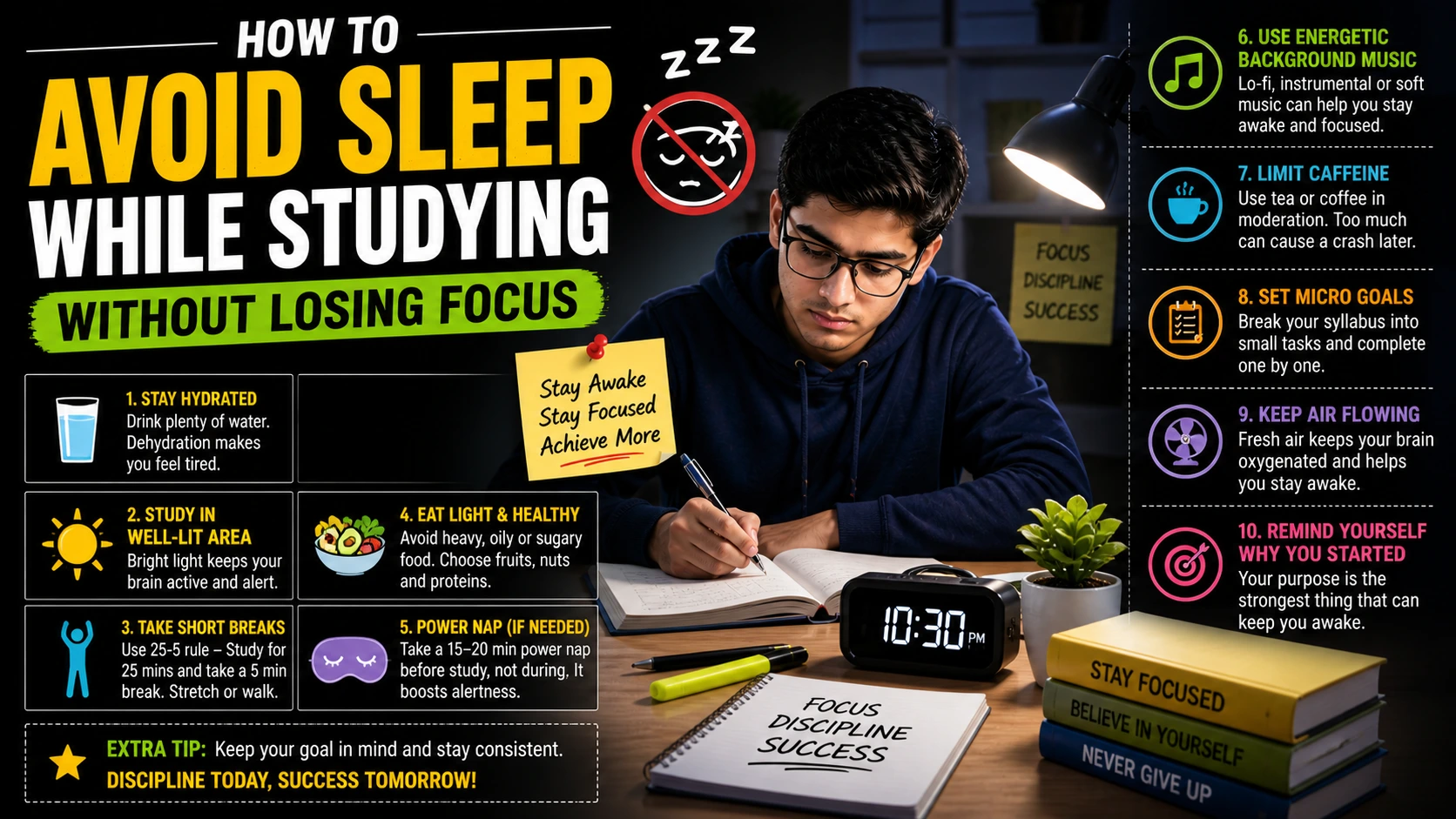
Falling asleep while studying is one of those student problems nobody likes to admit, but almost everyone has faced. You open the book with full motivation, underline two lines, yawn once, and suddenly the chapter looks like a lullaby. It happens after school, after tuition, late at night, during boring topics, and especially when exams are around the corner and your brain is already overloaded.
But here’s the important bit: the goal is not to fight sleep forever. Students need proper sleep to learn well. The real goal is to stay alert during planned study hours, avoid unnecessary drowsiness, and build a routine where your body and brain actually cooperate with you.
Why Do Students Feel Sleepy While Studying?
Sleepiness during study time is not always laziness. Often, it is your body sending a signal. You may be tired, dehydrated, mentally stressed, sitting in poor posture, studying in dim light, or trying to push through a topic for too long without breaks.
The CDC notes that good sleep supports health, learning, mood, and daily functioning. Similarly, the National Heart, Lung, and Blood Institute explains that sleep deficiency can affect attention, decision-making, and memory. So, if you are constantly sleepy while studying, the first question should not be “How do I force myself awake?” It should be, “Am I sleeping enough in the first place?”
For students, especially teenagers, late-night scrolling, school pressure, coaching classes, assignments, and exam stress can quietly reduce sleep quality. Then, when it’s time to study, the body simply says: bas, enough.
| Common Reason for Sleepiness | What It Does |
|---|---|
| Lack of sleep | Reduces focus and memory |
| Heavy meals | Makes the body sluggish |
| Dim lighting | Signals the brain to relax |
| Studying on bed | Makes sleep more tempting |
| Long study sessions | Causes mental fatigue |
| Stress and anxiety | Drains energy quickly |
| Dehydration | Leads to tiredness and low alertness |
1. Keep Moving When Drowsiness Hits
Sitting in the same position for hours can make even an interesting subject feel dull. When your body stays still for too long, your energy drops and your brain starts slowing down.
The fastest fix? Move.
Stand up, stretch your arms, walk around the room, do 10 squats, climb a few stairs, or take a short walk outside if it is safe. You don’t need a full workout. Even two to five minutes of movement can wake up your body.
This is especially useful during evening study sessions after school. Your brain may be tired from the day, but light movement can improve blood circulation and help you return to your desk with better attention.
| Feeling | Quick Movement Fix |
|---|---|
| Heavy eyes | Walk for 3 minutes |
| Stiff body | Stretch neck, shoulders, and back |
| Mental block | Step outside for fresh air |
| Low energy | Do 10 jumping jacks or squats |
| Restlessness | Walk while revising flashcards |
The trick is to move before you fall into that dangerous half-sleep zone where you are technically studying, but your mind is in another universe.
2. Study Under Bright, Comfortable Light
Dim light is sleep’s best friend. A soft lamp, cozy corner, and silent room may look aesthetic, but they can also make your brain think it is time to wind down.
Study in a well-lit place. Natural daylight is best during the day. At night, use bright but comfortable lighting that does not strain your eyes. Avoid studying under only a small bedside lamp, especially if you already feel tired.
Good lighting keeps your brain more alert and makes reading easier. It also reduces eye strain, which can otherwise make you feel sleepy faster.
| Lighting Setup | Effect on Studying |
|---|---|
| Dim yellow light | May increase drowsiness |
| Bright white light | Helps alertness |
| Natural daylight | Best for focus and mood |
| Screen-only light | Can strain eyes |
| Balanced desk light | Good for reading and writing |
Also, don’t study in complete silence if that makes you sleepy. Some students focus better with low-volume instrumental music or soft background sound. But keep it controlled. A study session should not become a private concert.
3. Eat Light, Healthy Food Before Studying
Your brain needs fuel. But there’s a difference between fuel and food coma.
A heavy meal, especially at night, can make you lazy and sleepy. Fried food, too much rice, sugary snacks, and overeating can slow you down. On the other hand, studying on an empty stomach can make you irritated and distracted.
Choose light, healthy snacks that give steady energy. Fruits, nuts, yogurt, roasted chana, peanut butter toast, eggs, cheese, or a small bowl of poha/upma can help. Dark chocolate in a small amount may also work for some students.
| Eat This | Avoid This Before Study |
|---|---|
| Fruits | Heavy fried food |
| Nuts and seeds | Too much sugar |
| Yogurt | Large oily meals |
| Eggs or paneer | Excess caffeine |
| Roasted chana | Skipping meals |
| Whole-grain snacks | Overeating late at night |
Drink enough water too. Dehydration can make you feel tired, foggy, and dull. Keep a water bottle near your study table. Simple, but effective.
4. Fix Your Posture
Studying while lying on the bed is basically an invitation to sleep. You may start with good intentions, but your pillow has other plans.
Sit upright on a chair, keep your back supported, and place your books or laptop at a comfortable height. Your study table should feel active, not sleepy. Avoid leaning too much, bending your neck for long periods, or curling up in a blanket while reading.
Good posture helps you stay alert. It also prevents neck pain, back pain, and fatigue during long study hours.
A simple rule: bed is for sleep, table is for study. Mixing both confuses your brain. When you study on the bed every day, your mind does not know whether it should focus or relax.
5. Switch Subjects Before Your Brain Switches Off
Studying the same topic for too long can drain your attention. This happens even with good students. The brain likes variety, especially during long study days.
When you feel bored or sleepy, switch the task. Move from reading to writing. Shift from theory to numericals. Change from history to maps. Move from science notes to diagrams. This small change can bring your attention back.
| If You Feel Sleepy While… | Switch To… |
|---|---|
| Reading theory | Writing short notes |
| Solving maths | Revising formulas |
| Learning history | Creating timelines |
| Reading science | Drawing diagrams |
| Memorising grammar | Practising questions |
Take a 5–10 minute break before switching. Don’t open social media during that break unless you have extraordinary self-control. Most students don’t. One reel becomes twenty, and then guilt enters the chat.
6. Read Aloud and Write More
Silent reading can quickly become passive. Your eyes move, but your brain may not fully engage. Reading aloud forces your mind to participate.
When you read aloud, explain a topic, or write key points, you activate more senses. This helps you stay awake and remember better. Writing is especially useful because it slows you down and makes you process the information.
Try this method:
| Step | What To Do |
|---|---|
| Step 1 | Read one small section |
| Step 2 | Close the book |
| Step 3 | Say the main idea aloud |
| Step 4 | Write 4–5 key points |
| Step 5 | Check what you missed |
This method works well for science definitions, social science answers, English literature themes, and even formula-based subjects.
7. Avoid Studying in the Bedroom
The bedroom is strongly linked with rest. That is why studying there can make you sleepy faster. The bed, blanket, pillows, and relaxed environment all signal comfort.
Choose a separate study space if possible. It does not need to be fancy. A small table in the living room, balcony corner, dining table, or quiet study area can work. What matters is that the space feels like a place for focus.
Keep your study materials ready before you begin. Books, pens, notebooks, water bottle, and timetable should be within reach. The more often you get up to search for things, the easier it becomes to lose focus.
8. Use Music Carefully
Music can help some students stay awake, especially during light revision, diagrams, organizing notes, or solving familiar questions. But it depends on the type of music and the task.
Fast, lively instrumental music may help with energy. Lyrics can distract you during reading-heavy subjects. Slow, sad songs may make you more relaxed and sleepy.
| Task | Best Music Choice |
|---|---|
| Maths practice | Low-volume instrumental |
| Note-making | Light energetic music |
| Reading theory | Silence or soft background sound |
| Memorisation | No lyrics |
| Break time | Favourite upbeat song |
Use music as a tool, not a distraction. If you are singing more than studying, the plan has clearly gone off track.
When Sleepiness May Need Attention
Occasional sleepiness while studying is normal. But if you feel sleepy all the time, even after resting, it may be linked to poor sleep quality, stress, low iron, dehydration, irregular routine, or another health issue. MedlinePlus, a service of the U.S. National Library of Medicine, explains that fatigue can have many causes, including lifestyle habits and medical conditions.
If daytime sleepiness is frequent and affects school, mood, or daily life, talk to a parent, teacher, school counsellor, or doctor. Don’t keep forcing yourself through it.
A Simple Anti-Sleep Study Routine
Here’s a practical routine students can follow:
| Time | Action |
|---|---|
| Before studying | Drink water, set goal, sit at desk |
| First 40–50 minutes | Study one focused topic |
| 5–10 minute break | Walk, stretch, wash face |
| Next session | Write, solve, or revise actively |
| After 2 sessions | Eat a light snack if needed |
| Before ending | Revise key points quickly |
The best way to avoid sleep while studying is to create a routine your body understands. Same place, same timing, proper light, active study, short breaks, and enough sleep at night. Nothing filmy. Just consistent.
Final Thoughts
Avoiding sleep while studying is not about punishing your body. It is about studying in a smarter way. Move when you feel dull, use bright lights, eat light and healthy food, sit properly, switch tasks, read aloud, write more, and avoid the bed while studying.
But never forget the bigger truth: sleep is not your enemy. Poor routine is. When you sleep well and study actively, concentration improves naturally.
Schools that focus on balanced learning, like leading international schools in Ahmedabad, often encourage students to build these habits early. Institutions such as GIIS can support students by promoting structured study routines, healthy academic discipline, and practical learning strategies that go beyond last-minute exam pressure.
A fresh mind learns faster. A tired mind only stares at the page. Choose wisely.
Frequently Asked Questions
How can I avoid sleeping while studying?
Study in bright light, sit upright, avoid the bed, drink water, take short movement breaks, and use active methods like writing, reading aloud, and self-testing.
Why do I feel sleepy whenever I start studying?
You may feel sleepy because of lack of sleep, boredom, poor posture, dim lighting, heavy meals, stress, or studying passively for too long.
Is it good to study late at night?
Late-night study works for some students, but it should not reduce your sleep. If you are too tired, sleeping and studying fresh in the morning is usually better.
What should I eat to stay awake while studying?
Choose light snacks like fruits, nuts, yogurt, eggs, roasted chana, paneer, or whole-grain snacks. Avoid overeating or consuming too much sugar.
Does music help in staying awake while studying?
Music can help during light tasks, but it should be low-volume and not distracting. Instrumental or upbeat music is usually better than slow songs with lyrics.